


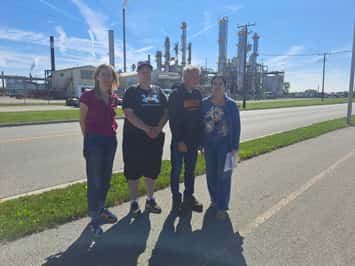
Questions some Chatham-Kent councillors have surrounding the amount of waste coming to the proposed anaerobic digester in Chatham each year are being addressed.
An April 27 council report noted 370,000 of waste a year, but the proposal in the Environmental Registry of Ontario (ERO) states up to a maximum of 900,000 tonnes of waste yearly.
On Friday at a news conference, the councillors questioned why there's such a large discrepancy and are urging the public to submit feedback at the ERO web page.
Councillor Alysson Storey believes the new scope makes the facility a new project that needs to come back to council because it seems it has almost tripled in magnitude.
"That volume of waste is almost the same as the Ridge Landfill [in Blenheim], which is the largest landfill in the province ," said Storey.
Councillor Rhonda Jubenville said this proposal should be taken with the same gravity as the Dresden dump proposal.
"What is the difference? Why are we not encouraging public consultation and response on this project, but yet we were encouraging it on the other one?" Jubenville noted.
Councillor Michael Bondy said the public should be very concerned with such a large waste recycling site because senior government policy could change over time, rendering it useless.
"I heard from three leading members of the agricultural community and they said environmentally there are massive risks to this. Financially there is massive risk because this is a policy driven project," added Bondy.
The councillors also wonder what type of waste would make up the difference in tonnage, adding they can't rule out human waste.
They also question if the facility would cost more if it's expanded, adding that the amount of truck traffic transporting the waste to the facility would also be a problem.
Darren Galbraith, General Manager of Chatham-Kent Public Utilities Commission, later responded to the questions, saying the 900,000 tonnes per year is not the amount of waste coming to the digesters, it is the total capacity of the facility.
Galbraith said the $160 million plan has not changed and conclusions people are making about the plant expanding are inaccurate.
Galbraith said the 370,000 tonnes per year that council approved is the primary organic feedstock digestion capacity, such as industrial clean organics, biosolids, and ethanol stillage.
The other 450,000 tonnes per year, already generated on-site at Greenfield Global, is a separate industrial wastewater stream, which will now be treated at the site prior to being discharged into the sewer, he noted.
The public feedback is open until June 4.