


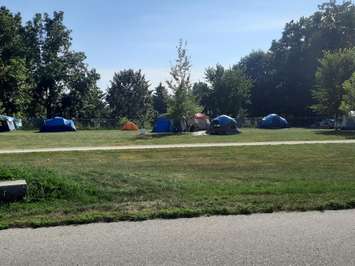
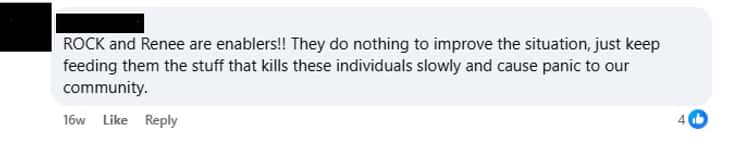
Several people who work for Reach Out Chatham-Kent (R.O.C.K.) are speaking out in hopes of clearing up what they believe is misinformation about efforts to help the homeless.
CK News Today was invited to a peer meeting to see firsthand some of the work being done behind the scenes.
It was during this meeting that multiple people offered to share their firsthand experience. This included Albert, a former addict who's been working with R.O.C.K. for a couple of years.
Albert shared his thoughts on harm reduction, specifically why he believes it does more good than harm.
Critics of harm reduction, which includes things like handing out clean needles, believe it is just enabling people with addictions. Albert understands why people feel this way, but argues that this helps reduce the spread of diseases.
"We don't care if we have clean supplies or dirty supplies, like I've seen people use water out of a mud puddle to help get their fix," said Albert.
He explained that if diseases like HIV and hepatitis are allowed to run rampant, our local healthcare system would be overwhelmed.
Albert also fought back at people who suggest that people should just stop using drugs or go to rehab, explaining that alcohol and drug abuse isn't something you can just quit, and going to rehab is a choice, not something that can be forced.

In Albert's opinion, harm reduction helps keep people alive.
"If we keep someone alive to the next day and we can instill trust in them, perhaps they'll decide to get clean and sober," he said.
There have also been concerns raised about drug use at the newly built transitional cabins in Chatham.
This issue was raised by Heather Brown, one of the 50 people living at the site. She told Chatham-Kent's (CK) council in November that she fears for her health and safety because of the constant drug use.
For at least one of Brown's neighbours at the site, her experience doesn't tell the story for everyone.
Shawn, who works and volunteers for R.O.C.K. just like Albert, currently lives in one of the cabins after spending more than two years on the streets. He became homeless after being unable to afford an increase in his rent.
He said his experience has been nothing but good.
"I like it. It's not a scary place to live, everyone keeps to themself," explained Shawn.
While he hasn't seen any drug use himself, Shawn believes it's definitely happening. Substance abuse is not a barrier to live at one of the cabins, with municipal officials instead trying to help users understand that their addiction is hurting their chances of finding a permanent home.
"People that are doing drugs are going to do drugs whether [R.O.C.K. or municipal officials] are here or not," added Shawn.
The last person to speak with CK News Today was Tiffany. Her experience is different from Albert's and Shawn's, as she isn't a recovering addict or has had to live on the streets.
She explained she had some preconceptions before joining R.O.C.K. After meeting several homeless people and hearing their stories, her opinion quickly changed.
"A lot of these people, regardless of where they're at right now, whether that be in substance abuse, homeless, both, or just struggling, all have some form of trauma," said Tiffany. "They're all just humans, and they all need something in different capacities."

For her, it's easy to understand why people have negative views about the homeless. It's the same for the work being done by R.O.C.K., as she explained that many only see the work being done on the streets.
Tiffany mentioned there's a lot of work being done to find housing, get people who are trying to beat their addictions into programs, and more.
"We're not just harm reduction, and I don't think people can see past that," she said.