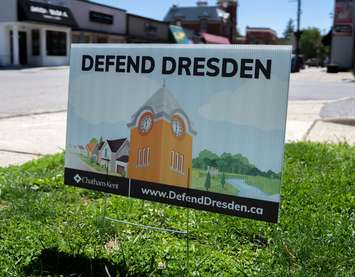
The Impact Assessment Agency of Canada (IAAC) has decided not to assess the environmental impact of the proposed Dresden landfill project.
Environmental activist group Dresden Citizens Against Reckless Environmental Disposal (C.A.R.E.D.) asked the IAAC last month to analyze the proposed project.
The lawyers representing the group said reviving the dormant landfill may cause adverse effects within federal jurisdiction, and that there is widespread public and Indigenous concern about the environment, species at risk, and habitats after the provincial government reversed a required environmental assessment for the project.
IAAC President Terence Hubbard said he decided not to designate the project pursuant to section 9 of the Impact Assessment Act.
"In making my decision not to designate the project, I considered whether the carrying out of the project may cause adverse effects within federal jurisdiction or direct or incidental adverse effects and concluded that the project may cause these adverse effects," wrote Hubbard. "I then considered public concerns related to these effects; adverse impacts on the rights of Indigenous Peoples; whether a means other than an impact assessment exists that would permit a jurisdiction to address the adverse effects within federal jurisdiction and the direct or incidental adverse effects; and other relevant factors identified in IAAC's Analysis Report."
Hubbard said he decided not to designate the project because federal and provincial legislation already exists to address public concerns related to the adverse effects within federal jurisdiction, or the direct or incidental adverse effects that may be caused by the carrying out of the project. He also noted that the law addresses the adverse impacts that the project may have on the rights of Indigenous Peoples.
Hubbard highlighted the Fisheries Act, Migratory Birds Convention Act, 1994, and Species at Risk Act, along with the Environmental Protection Act, Ontario Water Resources Act, Clean Water Act, 2006, Conservation Authorities Act, Endangered Species Act or Species Conservation Act, 2025 (once proclaimed), and Ontario Heritage Act.
"There are means other than an impact assessment that would permit a jurisdiction to address the adverse effects within federal jurisdiction and the direct or incidental adverse effects that may be caused by the carrying out of the project," Hubbard said.
Dresden C.A.R.E.D. said it is considering an appeal and will be meeting this week.
York1 Environmental Waste Solutions Ltd., based in Toronto, is proposing to construct and operate a waste disposal and regenerative recycling facility on Irish School Road in Dresden. The proposed project includes altering an existing landfill that would hold up to 1.62 million cubic meters of non-hazardous solid construction and demolition waste within an 8-hectare footprint, with a maximum daily limit of 1,000 tonnes. It also includes the expansion and alteration of an existing waste transfer station from 0.8 hectares to 25 hectares, to accept a maximum of 3,000 tonnes per day of recyclable materials and 1,000 tonnes per day of non-hazardous solid waste materials, including construction and demolition wastes and uncontaminated soil and soil-like materials.
The IAAC noted these physical activities are not "prescribed" by regulations made under paragraph 109(b) of the Impact Assessment Act (IAA).