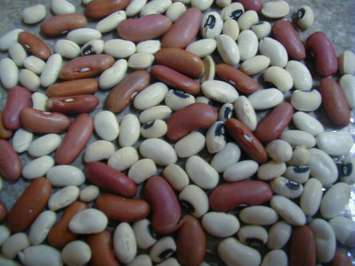
Edible bean acreage in Ontario was up sharply this year.
OMAFRA says white bean acreage was up 52 per cent over 2013 while overall coloured bean acreage was up by 21 per cent.
This year's white bean acreage was close to historic levels of 65 thousand acres.
The Ministry's Brian Hall says this year's yields were a mix of outstanding, average and ugly.
OMAFRA's Edible Bean Seasonal Summary suggests wet field conditions this fall will present a challenge in finding fields without compaction issues to plant beans into next year.
Root rot is the number one disease limiting edible bean yields on compacted soils.
Hall says there are few management options other than crop rotation and improving soil quality, organic matter levels and dealing with soil compaction with tillage.
===
Edible Bean Seasonal Summary:
Edible bean crop had high expectations, and in the end yields were a mix of outstanding, average and ugly. Acreage rose sharply on attractive contracting opportunities, lower prices for corn and soybeans and fewer acres of winter wheat being seeded. Acreage of white beans was up 52% over 2013 and close to historical levels to 65,000 acres. Coloured bean acreage also increased, but to a lesser extent. Final acreage of all coloured bean classes’ increased by 21% over 2013 to 52,700 acres. The biggest acreage increases in coloured beans were in kidney and Japanese/other category. The majority of the crop was planted on time and into good soil conditions. Emergence was generally excellent, except where soil conditions were very dry. Heavy rainfall, and saturated soil conditions following emergence stressed the crop and root rot became a common problem. Cool summer conditions with good soil moisture helped the crop recover, producing lush canopies and subsequent good seed set and grain fill. Harvest started 2-3 weeks later than normal. Yields were average to excellent where timely harvest occurred. Seed size and quality was quite good and held up reasonably well throughout harvest. The introduction of Eragon herbicide proved very timely with the delayed harvest this season. Growers were pleased the effectiveness and speed of desiccation it provided, allowing harvest to occur in 7-10 days following application.
Insects and Diseases: There were few insect issues in 2014. Leafhopper pressure was low, but there were more reports of damage by western bean cutworm. Conditions for white mould development were ideal and some fields received 2-3 applications of a white mould fungicide. These same weather conditions were ideal for anthracnose, although the disease failed to develop, a testament to the value of certified anthracnose ‘free’ seed. Bacterial blight was more prevalent this season, although it did not significantly affect yield or seed quality. Bacterial brown spot appeared for the first time in many adzuki beans fields in early August, infecting leaves, stems and pods, resulting in serious plant decline. Rain, fog and moderate temperatures provided ideal conditions for spread of the disease through adzuki bean fields. Some adzuki growers tried spraying a bactericide (i.e. copper hydroxide) to try and limit the spread with mixed results. Subsequent warm and dry weather conditions helped limit the spread. Both yield and quality were seriously reduced in heavily infected fields.
Management in 2015: Wet field conditions this fall present a challenge in finding fields without compaction issues, which will be suitable for edible beans in 2015. The effects of deeper compaction cannot necessarily be fixed by tillage alone and its effects often last for more than one season. Root rot is the number one disease limiting edible bean yields on compacted soils. There are few management options other than crop rotation and improving soil tilth (quality), organic matter levels and dealing with soil compaction. Edible beans are very susceptible to the effects of tillage, soil compaction and poor soil structure. Soil management that builds soil structure and minimizes crop stress through the use of cover crops, the maintenance of a 3-4 year crop rotation (all crops), the management of residue and the addition of organic amendments, like manure, all reduce production risks and increase bean yields. There is continued interest in trying direct harvest large seeded coloured bean types. This works best where plants are upright, with good pod height in uniform and level fields with adequate seed moisture at harvest. Further work on modifying harvest equipment and practices (e.g. crop lifters etc.) need to be explored. Edible beans only cover the soil for 3 months of the year, predisposing the crop and soil to damage and serious erosion. A number of farmers have successfully adopted strip and reduced tillage systems for growing edible beans. Reduced tillage and strip tillage systems need to be studied further and adoption encouraged.