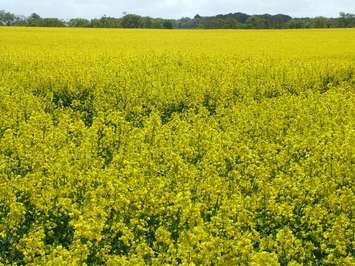
Ontario canola yields were higher than the long term average this year, but the number of acres planted to the crop was way down.
OMAFRA is reporting the provincial average yield came in at 1 tonne per acre - 17 per cent higher than the long-term average.
However, 2014 acreage was down 47 per cent from 2013.
The biggest reduction was in Northern Ontario, which saw a 70 percent cut.
OMAFRA's Brian Hall says much of that can be attributed to the risks posed by swede midge, although a drop in the price of canola was also a factor.
Looking ahead to next year, Hall is recommending growers plant early to lower the risk of swede midge damage.
He suggests growers consider rotating out of canola for 2-4 years in infested fields.
Hall also says canola should not be planted close to previous year's fields.
===
Ontario Field Crop Report November, 2014
Canola and Edible Bean Seasonal Summary - Brian Hall Canola Seasonal Summary: The 2014 canola acreage declined by 47% from 2013 to an estimated 22,000 acres. Northern Ontario farmers reduced plantings the most by nearly 70%, to 5600 acres. Much of the acreage decline can be attributed to the risks posed by swede midge, although a drop in canola price was also a factor. This wear was characterized by cooler temperatures and above average rainfall. Good field work and harvest days were often hard to come by. The season started out cold and wet, which delayed spring planting. Only 20% of intended acreage was planted by the second week of May. Northern areas experienced soil conditions that were just the opposite; soil conditions were often very dry, resulting in delayed and uneven emergence. In southern regions, heavy rains and soil crusting also resulted in reduced stands and uneven emergence. Cool and damp conditions continued through the summer, which improved vegetative growth and secondary branching, which helping to fill in thin canopies. Flowering was extended, often lasting 3 weeks, which was ideal for seed set and fill. Maturity and harvest were delayed by the late spring planting, cool growing season, slow crop dry down and wet fall weather. Harvest only got underway in September and was not fully completed until the end of October. Stubbornly high seed moisture required drying. Yields were average to above expectations at 1 to 1.5 t/ac, except for in northern areas where severe swede midge damage pulled back yields to 0.5 - 0.75 t/ac. Green seed content was higher than normal due to uneven maturity. Provincially, the average reported yield stands at 1 t/ac (2193 lb/ac), which is 17% higher than the long term average of 0.86 t/ac. Some acres remain in the field in Northern Ontario.
Pests and Diseases: Flea beetle populations were much lower than that experienced the past several years. Swede midge emerged in late May-June, which is later than in previous years. Populations were often lower than in 2013, except for northern Ontario where populations were extremely high. Early season damage to canola was particularly problematic in the Dundalk highlands area and in northern Ontario. Control often appeared inadequate and significant injury to canola in the rosette stage was evident. Subsequent growth and recovery of damaged canola was better than anticipated, owing to good growing conditions and compensatory growth. Canola plants often branched extensively to compensate for damage and stunting of the main raceme. Swede midge did have significant impact on yields where pressure was greatest, reducing yields by 20 to 50%. Affected fields matured unevenly due to the extensive secondary branching. The incidence of sclerotinia white mould was higher this year, with the greatest yield reductions occurring in late planted canola.
2015 Management: Plant canola early to lower the risk of damage from swede midge. April planted canola escapes serious damage because plants are in late-rosette to bolting stage when the first peak of overwintering midge emerges. Depending on your area, it may be best to plant canola first. Swede midge can survive in the soil for at least 2 years. In infested fields, consider rotating out of canola for 2 to 4 years, also canola should not be planted close to previous year’s fields. Dupont’s new Lumiderm insecticide seed treatment will be of benefit to broaden control of flea beetles, including stripped flea beetles. 2014 strip trial comparisons with this new seed treatment did not show stand improvement or yield benefit, although flea beetle populations were generally low.