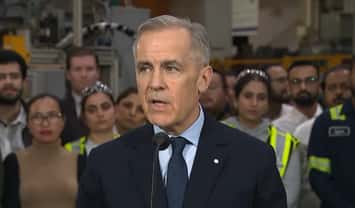
Even before Prime Minister Mark Carney unveiled the plan at a manufacturing plant in Vaughn, there were leaks that the plan would eliminate the electric vehicle mandate for automakers and bring back rebates for drivers who buy an electric vehicle.
That was confirmed in the announcement on Thursday morning, but Carney also announced new measures to support auto workers, new investments in charging infrastructure, and a new automotive task force with Ontario.
On those rebates, Ottawa is launching a five-year $2.3-billion EV affordability program that will refund car buyers up to $5,000 for electric vehicles, and as much as $2,500 for plug-in hybrid vehicles for those that cost less than $50,000. The program will start on February 16.
The rebates won't apply to new Chinese EVs entering Canada. They will only apply to vehicles made domestically or imported from countries with a free trade deal with the country.
The trade agreement with China that will allow the import of 49,000 Chinese-made EVs was the source of acrimony between the Prime Minister and Premier Doug Ford. Carney announced Ottawa and Queen's Park will be working more closely together.
"We're launching the automotive task force to drive coordinated action between our government and the province of Ontario to build the cars of the future," said Carney. "We're breaking down barriers and working together across government, industry, and labour with a shared focus on delivery."
Revoking the electric vehicle mandate was an ask from the auto industry. The mandate called for 100 per cent of all vehicle sales to be emission-free by 2035.
The EV availability standard, on pause since last fall, will be repealed, and in its place, new greenhouse gas emissions standards for vehicle years 2027 to 2032 will be established. The federal government hopes to have 75 per cent of vehicle sales be electric, and by 2040, 90 per cent.
For auto workers, "we're providing additional income supports to workers and employers through a new worksharing grant, giving themthe flexibility that employers need to retain workers and prevent layoffs," said Carney.
He said grants have already saved 3,700 workers from the unemployment line.
Workers will also get employment assistance and funding to reskill.
Much of Carney's announcement was centred on growing Canada's automotive industry and reducing reliance on the U.S. That said, he told reporters Ottawa is working with the Detroit Big 3 to retool plants.
To grow investment domestically, the federal government is committed to allocating $3-billion from the Strategic Response Fund and $100-million from the Regional Tariff Response Initiative to sweeten the pot so car companies accelerate their investments.
Carney also pointed to recent trips to Asia, saying Ottawa is in negotiations now with car companies from countries like Korea.
With more electric vehicles on the road and to allay fears about charging infrastructure, the federal government is promising $1.5-billion to improve EV charging infrastructure across Canada.
The growth of electric vehicles will put strain on the electricity grid, so Carney said a new electricity strategy will be announced in the coming weeks.