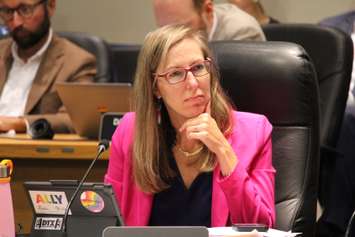
As municipal leaders from across Ontario gather for the Rural Ontario Municipal Association (ROMA) Conference this week, Chatham-Kent (CK) Councillor Alysson Storey says she will be using the opportunity to push for greater provincial and federal support on infrastructure, housing, health care, and municipal governance issues.
One of the key issues Storey plans to discuss is the municipality’s aging water and wastewater infrastructure.
According to municipal administration, CK is facing nearly $2 billion in infrastructure work over the next decade, with a significant portion tied to water and wastewater systems.
Unlike many municipalities that operate a single treatment facility, CK is responsible for multiple water and wastewater plants. Storey says this creates additional financial pressure and underscores the need for provincial and federal support.
She adds that infrastructure funding is also directly tied to the province’s housing goals.
While the municipality wants to help address Ontario’s housing shortage, she stressed that new homes cannot be built without the necessary water and wastewater capacity in place.
During the conference, the CK councillor is scheduled to attend a delegation with Minister Rob Flack on the Municipal Act and integrity complaint process on her own.
Storey says she will be raising concerns about Ontario's current integrity commissioner system. Along with councillors from across the province, they are scheduled to meet with Minister Rob Flack to discuss what she describes as shortcomings in the effectiveness, fairness, and transparency of the current enforcement model for integrity complaints.
The councillor is advocating for targeted amendments to the Municipal Act that would remove an integrity commissioner's authority to suspend an elected official’s pay. They argue that the current system relies too heavily on punitive measures and should instead focus on corrective, restorative, and education-based approaches.
According to the councillor, the potential for pay suspension can discourage open debate at council tables, particularly for new councillors, under-represented groups, or those who hold minority viewpoints. The issue has been raised publicly in recent years by several municipal associations, including the Association of Municipalities of Ontario and the Association of Municipal Clerks and Treasurers of Ontario.
Storey, who has personally experienced the integrity complaint process, says stronger accountability can be achieved without measures that threaten the financial security of elected officials, and that healthy municipal democracy depends on the ability of diverse voices to participate freely.
She and the rest of the party from Chatham-Kent, including councillors Amy Finn, Jamie McGrail, and Carmen McGregor and municipal staff Dave Taylor, Audrey Ansell, Scott Sparling, will also meet with officials from the Ministry of Municipal Affairs and Housing, the Ministry of Environment, Conservation and Parks, and the Ontario Medical Association. Planned discussions will focus on brownfield redevelopment, housing, and health care access.
As a former manufacturing hub, Chatham-Kent has a number of well-located, fully serviced former industrial properties that could be redeveloped for housing. According to Storey, these sites require environmental remediation, which can be costly. she adds provincial support for remediation would help accelerate housing development while making use of existing infrastructure.
Health care access is also expected to be a major topic. Councillors plan to highlight concerns about the lack of primary care practitioners in Chatham-Kent and to discuss how the municipality is aligning with provincial priorities through preventive care initiatives, including community paramedicine programs and public health engagement.
The ROMA Conference runs from Sunday through Tuesday afternoon.